
Explaining the Predictive Brain to a Predictive Brain
How can you explain a niche topic you’re passionate about in a way that makes others enthusiastic about it, too?
Since learning about predictive coding, I’ve felt like a predictive coding evangelist at times. I’ve probably explained the framework dozens of times, to colleagues, friends, and anyone else I suspect may be receptive to its merits. I feel very passionate about the topic, and I would like others to share in the enthusiasm.
The explanation I give often starts with a brief and hopefully thought-provoking primer. I’ll say something about how predictive coding is a theory that turns the brain upside down. Instead of seeing the brain as an information-processing machine, where sensory information comes in as raw data that is processed into lines and shapes (in the case of vision), and then into ideas and abstract concepts, predictive coding sees the brain as a prediction machine that hallucinates reality, and tries to anticipate what is going to happen until it is contradicted by incoming sensory data. This is the core business of the brain, and it happens at several levels of abstraction.
This gives people a general idea of predictive coding. Now they want to know why I’m telling them this. I’ve arrived at a fork in the road. The direction I choose next feels important to how enthusiastic people end up being. Choosing this direction is a matter of aligning with the other person’s priorities and concerns.
For the more biologically-oriented people, I could talk about the tenfold larger number of top-down neuronal connections compared to bottom-up neuronal connections in parts of the visual system.1Mark Solms’ The Hidden Spring, p.121: ”[T]he ratio of incoming connections to outgoing ones in the lateral geniculate body (which relays information from the eyes to the visual cortex and vice-versa) is about 1:10.”← This can provide some early ground support for venturing into examples of how predictive coding shapes our interaction with the world. I may continue with how interesting behavior of healthy brains can be explained using predictive coding. All sorts of illusions lend themselves well for this.
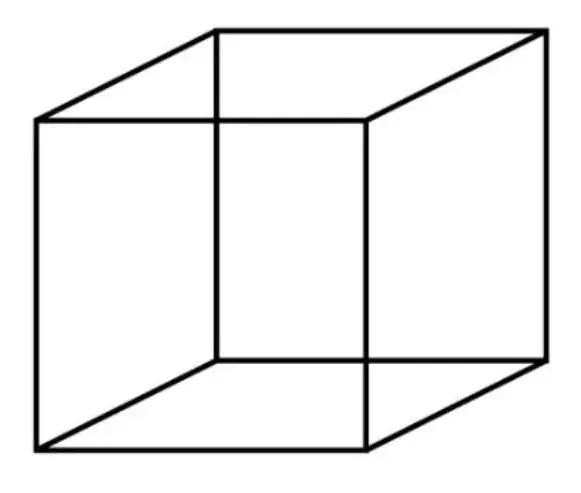
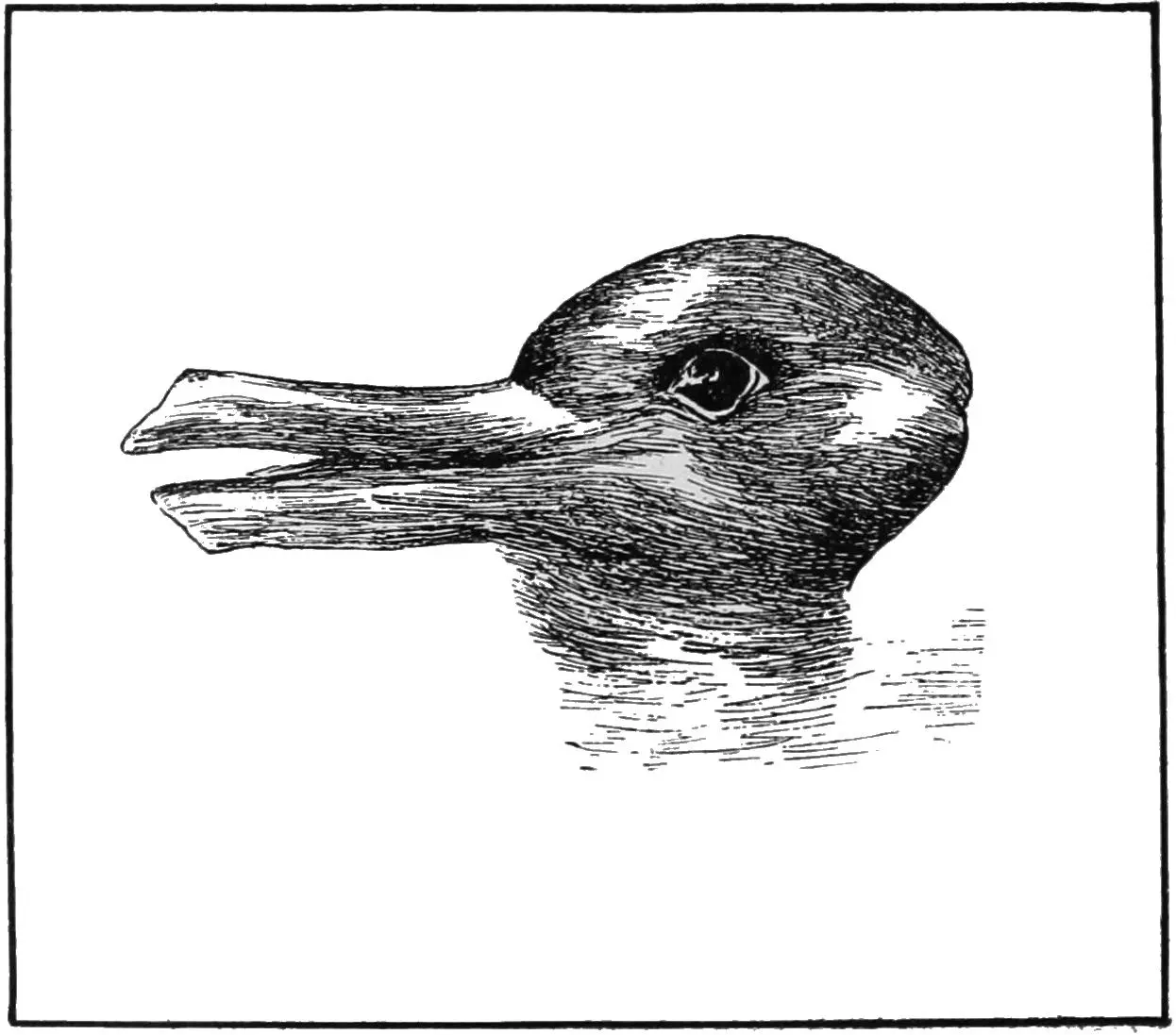
I often use the face–vase illusion (Fig 1) to explain how the testing of two competing hypotheses with equivalent confidence — ‘it’s a face’ vs. ‘it’s a vase’ — could lead to oscillating interpretations of the same image, where either hypothesis is just as likely to prevail over the other. Predictive coding offers an explanation for why we see just one option at a time, rather than a blend, and why the two take turns: whichever hypothesis is active leaves part of the evidence unexplained, and that leftover prediction error can eventually come to favor the rival explanation again. There are plenty of examples of ambiguous images that lend themselves to multiple interpretations that illustrate the point just as well, like the Necker cube (Fig 2), the duck-rabbit (Fig 3), the saxophonist or woman’s face (Fig 4), or “My Wife and My Mother-in-law” (Fig 5).



There are even ambiguous audio fragments, such as the “Brainstorm” vs. “Green needle” illusion (Fig 6), where, depending on which of the two the listener focuses on before listening, they usually hear one or the other.
Whereas the previous illusions allowed two competing interpretations that take turns, the hollow face illusion (Fig 7) shows that a strong enough expectation can win even against changing evidence. As the hollow mask rotates, we keep seeing a face that bulges outward, because every face we have ever seen does. Our confidence in this expectation is so strong that we are unable to view a hollow face despite knowing the truth. All of the examples above, the hollow face as well as the ambiguous images, can be described with a single mechanism: predictions and prediction errors weighted by their precision.
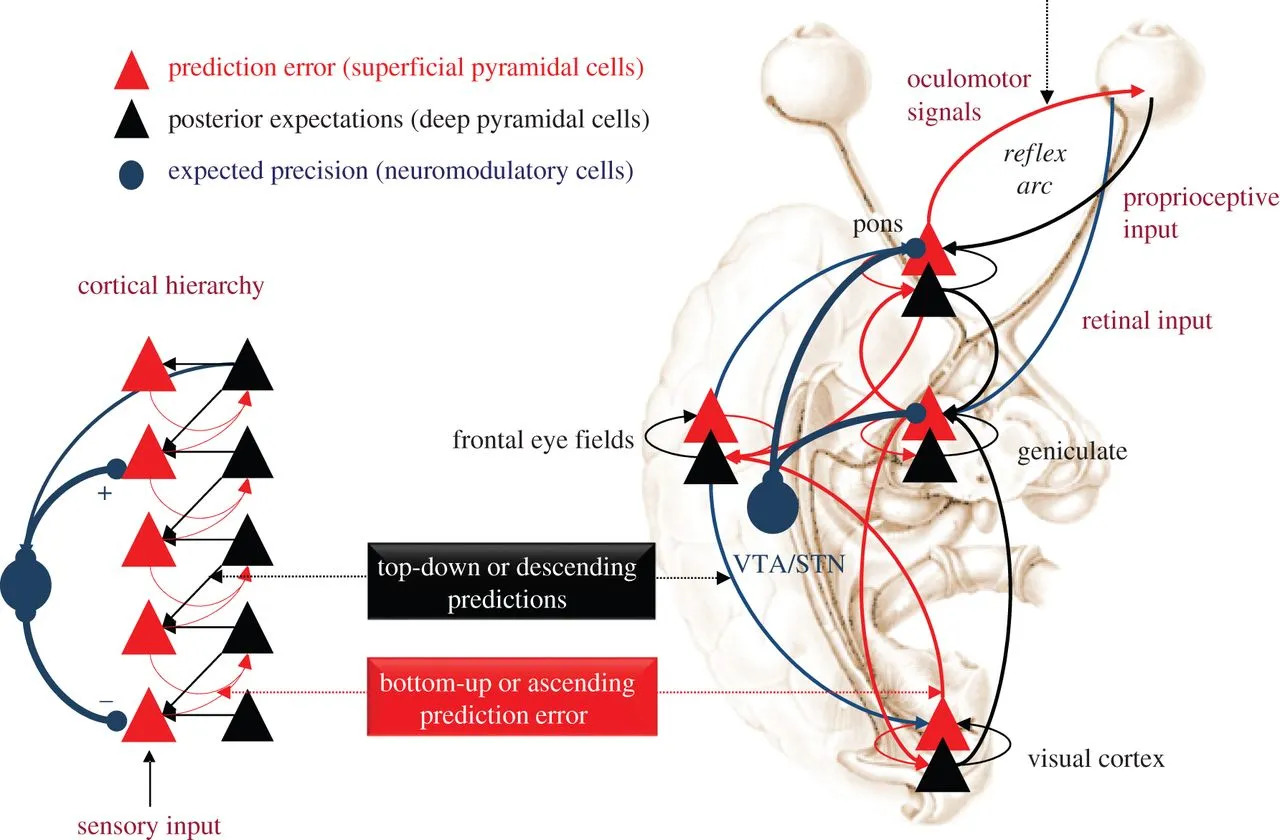
And if they’re really into brain biology, I could continue talking about how predictive coding really does seem to be represented in neuronal configurations (Fig 8) .2Bastos et al. (2012)PDF reports a “remarkable correspondence between the microcircuitry of the cortical column and the connectivity implied by predictive coding”.←
For the more psychologically oriented people I lean more towards an evolutionary approach because it ends with the function of emotions in all of this. I’ll start with how bacteria have sensors for things like acidity, too much of which is bad for their survival. When it detects acidity increasing as it moves in some direction, it helps to predict that acidity will probably keep rising if it continues that way. In a sense, this is already a rudimentary world model. As animals became more complex, simple ‘if-then’ rules were no longer sufficient. What is ‘good’ and what is ‘bad’ is no longer a matter of changing physical direction. It becomes a matter of combining and aligning multiple competing factors and interests. Humans had to decide whether to move the camp, whether to harvest a crop, whether to do the dishes. There is no ‘if-then’ rule that helps with this: you need a proper world model. And if the world model doesn’t seem to work sufficiently, consciousness guided by affect may be there to help us navigate such uncertain situations. Affect may then signal to our conscious mind the most pressing need and help us focus on those prediction errors that are most salient in satisfying that need.
For the more clinically oriented people, I would pivot towards examples of how mental illness can be understood in predictive coding terms. I find psychosis easiest here, in part because the aberrant salience hypothesis lends itself very well to a predictive coding explanation. I’ll say something like: when a car drives by a second time, it may be that for a brief moment we entertain the idea that they may in fact be keeping an eye on us. As soon as they are out of view, however, we will probably assign such low confidence to this theory that we soon forget about it. Someone who is very paranoid, however, may put a lot of unwarranted confidence in such a theory. The car passing by then fits neatly into their prediction of a threatening world where anyone could be out to get them. Two people can look at the same scene and come away with different perceptions and different meanings. Or something about how anxiety often has much to do with overconfidence in catastrophic outcomes, or how medication could create room for new interpretations. Or how adverse childhood events can instill beliefs in people about themselves and others that color their interpretation of social interactions for the rest of their lives.
At this point, most people will have become somewhat interested in predictive coding, or they wouldn’t have kept up with this for so long. Hopefully their questions will now help keep the fire going by itself. Still, there is one more direction I would like to steer them in. Because most examples I’ve given so far are rather high-level and impressionistic, especially psychologically-minded people who haven’t yet heard any biological examples may take predictive coding as a theory that is valuable mostly in a conceptual way: a metaphor to think about brain and mind, just like many psychotherapeutic orientations are. What is missing is the case that predictive coding may be more than a metaphor: it could literally and generally explain brain functioning.
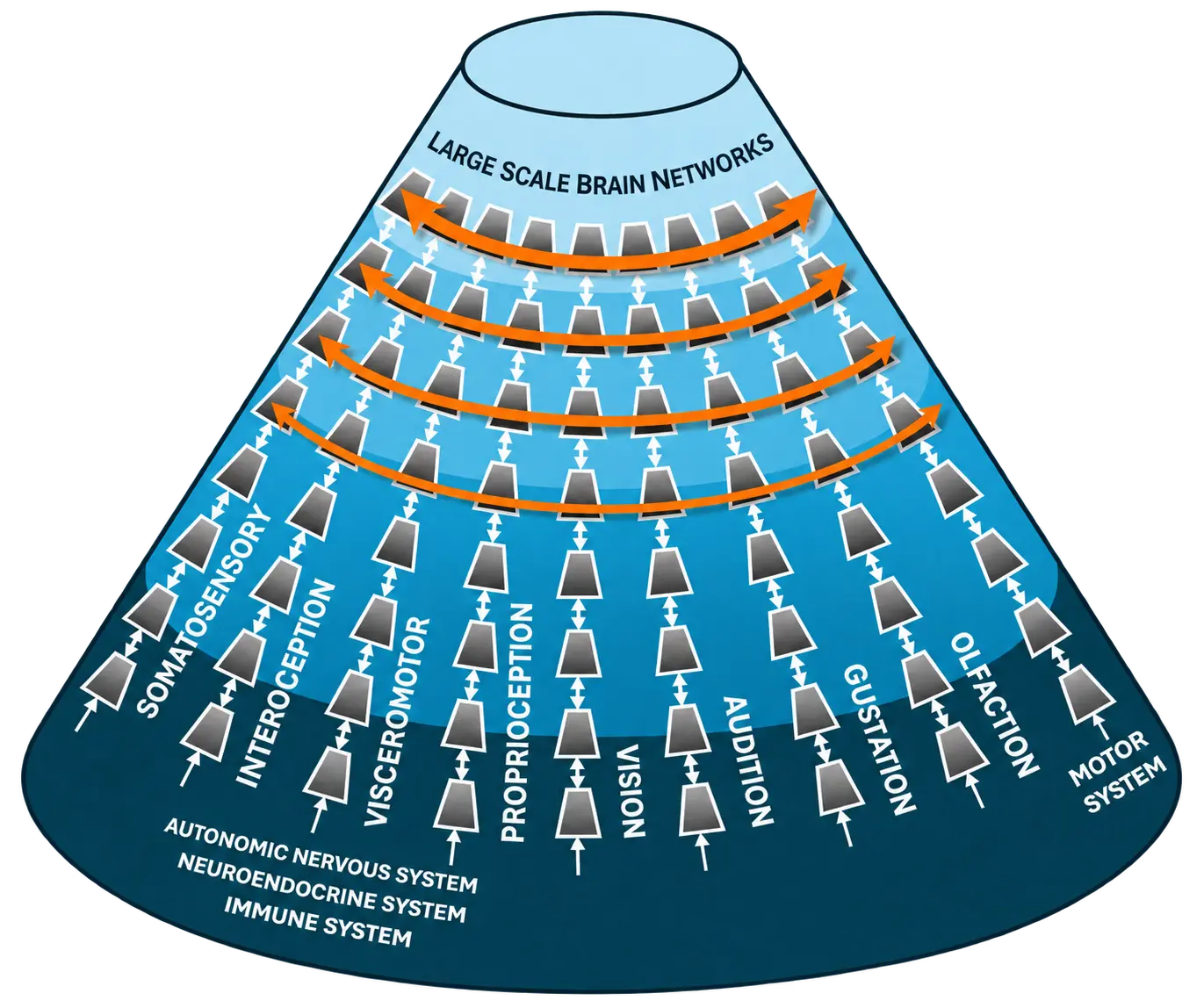
It doesn’t just offer an intuitive way of understanding higher-level cognitions about interpersonal beliefs; it is proposed to be a testable computational principle that may work at every level of brain functioning. In this view, the brain is a hierarchical structure where the lowest levels are closest to the outside world. At every level of this hierarchical structure, predictions are made about the level below (Fig 9). Correct predictions explain away incoming sensory signals, while mismatches between predictions and incoming signals generate prediction errors. But not all errors are equal.
Here is a simplified illustration of how this may work. Say we’re looking at a tomato, and a small region in our visual field suddenly produces a signal suggesting bright blue. Because neighboring areas report red, and our model expects tomatoes to be red, this is contrary to our expectations. This prediction error is then propagated upwards, to a level that “oversees” a larger part of the visual field. Because surrounding regions indicate red, the brain may infer that the blue signal is unreliable and assign it a low precision. Consequently, it has little influence on our perception, and we continue to see a uniformly red tomato. But if the blue signal persists, the brain may increase the prediction error’s precision, potentially leading us to revise our interpretation: perhaps the tomato really does have a blue dot in its center.
But that is not all. In addition to updating our interpretation of the world, we can move our eyes or bodies to gather new information about the world to test our predictions. We can move our eyes and turn our head to inspect the suspected blue dot more closely, or pick up the tomato to rotate it in our hand. Such actions can help us determine whether the blue dot is really there or whether the original signal was unreliable. This is an example of active inference: acting to align sensory input with our predictions and reduce uncertainty about the world.5Active inference distinguishes between epistemic actions, aimed at reducing uncertainty, and pragmatic actions, aimed at achieving preferred outcomes. Both minimize expected free energy.←
All the while, I experience a great deal of uncertainty. Am I boring them? Are they still with me? Did my metaphor tickle them in the right way? Are they expecting more scientific evidence? Have I anticipated their natural ‘so what?’ response? Did they prefer a utility-first approach rather than an evidence-first approach? I gauge these things before, during, and after my explanation.
The process by which I do this is itself an example of predictive coding.
I have a generative model of my listener in mind, predicting which examples will resonate with them, which concepts they’ll understand, and which arguments they may raise. I encounter prediction errors: confused facial expressions, unexpected questions, a distracted glance at the clock. I interpret these prediction errors and adjust their assigned precision: an unexpected question may suggest engagement rather than a critical stance, while a distracted glance at the clock may mean very little on its own. I may update my model of them, concluding I may be on the right path after all, or I may act by switching metaphors or checking whether I am indeed boring them.
To learn more about predictive coding:
- Recommended books: Antonio Damasio’s The Strange Order of Things, Mark Solms’ The Hidden Spring;
- Recommended listening: the first 30-45 mins of Anil Seth on the Within Reason podcast↗, Karl Friston on the Lex Fridman podcast↗;
- Academic papers worth exploring: Karl Friston’s seminal 2010 paper “The free-energy principle: a unified brain theory?”PDF, Karl Friston - Computational psychiatry: from synapses to sentiencePDF;
Curious to explore how predictive coding might be applied in mental health care? So am I. Drop me a message to start the conversation. Just do it!